Linguistics Graduates share their post-SDSU experiences.

Linguistics Student Association @ SDSU
Department of Linguistics and Asian/Middle Eastern Languages
Linguistics Graduates share their post-SDSU experiences.
Dr. Drew Fagan is Clinical Professor of Applied Linguistics and Language Education and the Director of the Ed.D. in School System Leadership Program- Specialization in TESOL and Dual Language Education, TESOL Teacher Leadership Master’s Program, and the TESOL Certificate Program at the University of Maryland. His scholarship focuses on promoting multilingualism and language education in inter- and cross-disciplinary leadership development, educator preparation, and educational policymaking. He is currently a member of the TESOL International Association Board of Directors and was the 2022-2023 President of the Maryland TESOL Association. He is also the recipient of the 2026 Distinguished Public Service Award for the American Association of Applied Linguistics and the 2023 Teacher of the Year Award for the TESOL International Association and National Geographic Learning.

Lina Hou (she/they) is a signed language linguist. She is an Associate Professor and Director of Graduate Studies in the Linguistics Department at University of California, Santa Barbara. She received her PhD in Linguistics at the University of Texas at Austin and did her postdoctoral fellowship in Communications at University of California, San Diego.

Aaron Dinkin is an associate professor of Linguistics at SDSU. He received his PhD from the University of Pennsylvania in 2009, under the supervision of William Labow, and has also held faculty positions at Swarthmore College and the University of Toronto. His research centers on sound change in dialects of American English, especially in upstate New York.

Dr. Soonja Choi
Department of Linguistics
University of Vienna
and
Department of Linguistics and Asian/Middle Eastern Languages
San Diego State University
11:00am-12:00pm
March 20, 2019
SH 109
Abstract
Regardless of culture and language, we routinely talk about the events we experience and make efforts to be clear and efficient in our communication (Grice 1975). This is true of one of the most frequent event types, motion events (Talmy 1978) having to do with movement of objects, such as putting cup on table. In these events, the moving object (e.g., cup) is the Figure and the reference object (e.g., table) is the Ground. The two entities have distinct perceptual properties and assume conceptually asymmetric roles: Figure(F) is the entity moving along a trajectory (e.g., onto, into) whereas Ground(G) serves to be the non-moving reference frame.
Comparing between German and Korean speakers, I present variation in linguistic description and cognitive behaviors for motion events. In particular, I examine (i) the degrees to which German and Korean speakers differentiate between F and G semantically (spatial terms) and syntactically (grammatical roles: subject, object) and (ii) their eye-gaze and memory patterns of F and G. In the linguistic study, participants described dynamic video events involving two objects that systematically switched their F-G roles (e.g., put cup(F) on table(G) and put table(F) under cup(G)). German speakers used distinct spatial terms (e.g., auf ‘on’, unter ‘under’) for opposing F-G relations, thus encoding the F-G asymmetry. In contrast, Korean speakers frequently used the same terms (e.g., kkita ‘fit.tightly’) and the same syntactic constructions regardless of the switches in F-G roles. These crosslinguistic differences were more evident for Non-typical events (put table under cup) than for Typical events (put cup on table), showing that linguistic encoding interacts with degree of familiarity of these events in the real world. The differences also reflect language-specific spatial semantics and differences in the way the two languages perspectivize/contextualize the Figure-Ground relation.
German and Korean speakers also differed in perceptual/cognitive behaviors: German speakers looked longer at the Figure particularly in Non-typical events (compared to Typical events), but Korean speakers showed no such difference. In the memory test, German speakers were better than Korean speakers in remembering which object moved, i.e., the Figure. I relate these behavioral differences between German and Korean speakers to their differences in linguistic representation of Figure and Ground.
References:
Choi, S., Goller, F., Hong, U., Ansorge, U., and Yun, H. (in press). Figure and Ground in spatial language: Evidence from German and Korean. Language and Cognition.
Grice, P. (1975). Syntax and semantics.
Talmy, L. (1978). Figure and ground in complex sentences. In J. Greenberg, C. Ferguson, & E. Moravcsik (Eds.), Universals of human language (pp. 627–649). Stanford Univ. Press.
Thiering, M. (2015). Spatial semiotics and spatial mental models: Figure-Ground asymmetries in languages. (Applications of Cognitive Linguistics). Berlin: Mouton de Gruyter.
This event is co-sponsored by the Dept of Linguistics and Asian/Middle Eastern Languages and the SDSU Linguistics Student Association, and is supported by the College of Arts & Letters Instructionally Related Activities Fund.
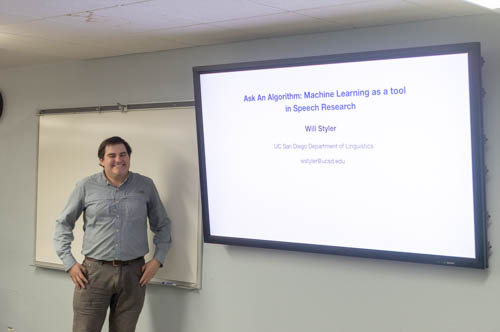
Dr. Will Styler
Linguistics Department
University of California, San Diego
3:00pm-4:00pm
March 8, 2019
SH 109
Abstract
Machine learning, the use of nuanced computer models to analyze and predict data, has a long history in speech recognition and natural language processing, but have often been limited to more applied, engineering tasks. This talk will describe two more research-focused applications of machine learning in the study of speech perception and production.
For speech perception, we’ll examine the difficult problem of identifying acoustic cues to a complex phonetic contrast, in this case, vowel nasality. Here, by training machine learning algorithms on acoustic measurements, we can more directly measure the informativeness of the various acoustic features to the contrast. This by-feature informativeness data was then used to create hypotheses about human cue usage, and then, to model the observed human patterns of perception, showing that these models were able to predict not only the utilized cue, but the subtle patterns of perception arising from less informative changes.
For speech production, we’ll focus on data from Electromagnetic Articulography (EMA), which provides position data for the articulators with high temporal and spatial resolution, and discuss our ongoing efforts to identify and characterize pause postures (specific vocal tract configurations at prosodic boundaries, c.f. Katsika et al. 2014) in the speech of 7 speakers of American English. Here, the lip aperture trajectories of 800+ individual pauses were gold-standard annotated by a member of the research team, and then subjected to principal component analysis. These analyses were then used to train a support vector machine (SVM) classifier, which achieved a 96% classification accuracy in cross-validation tests, with a Cohen’s Kappa showing machine-to-annotator agreement of 0.79, suggesting the potential for improvements in speed, consistency, and objective characterization of gestures.
These methods of modeling feature importance and classifying curves using machine learning both demonstrate concrete methods which are potentially useful and applicable to a variety of questions in phonetics, and potentially, in linguistics in general.
This event is co-sponsored by the Dept of Linguistics and Asian/Middle Eastern Languages and the SDSU Linguistics Student Association, and is supported by the College of Arts & Letters Instructionally Related Activities Fund.
